Sensory & Fine Motor
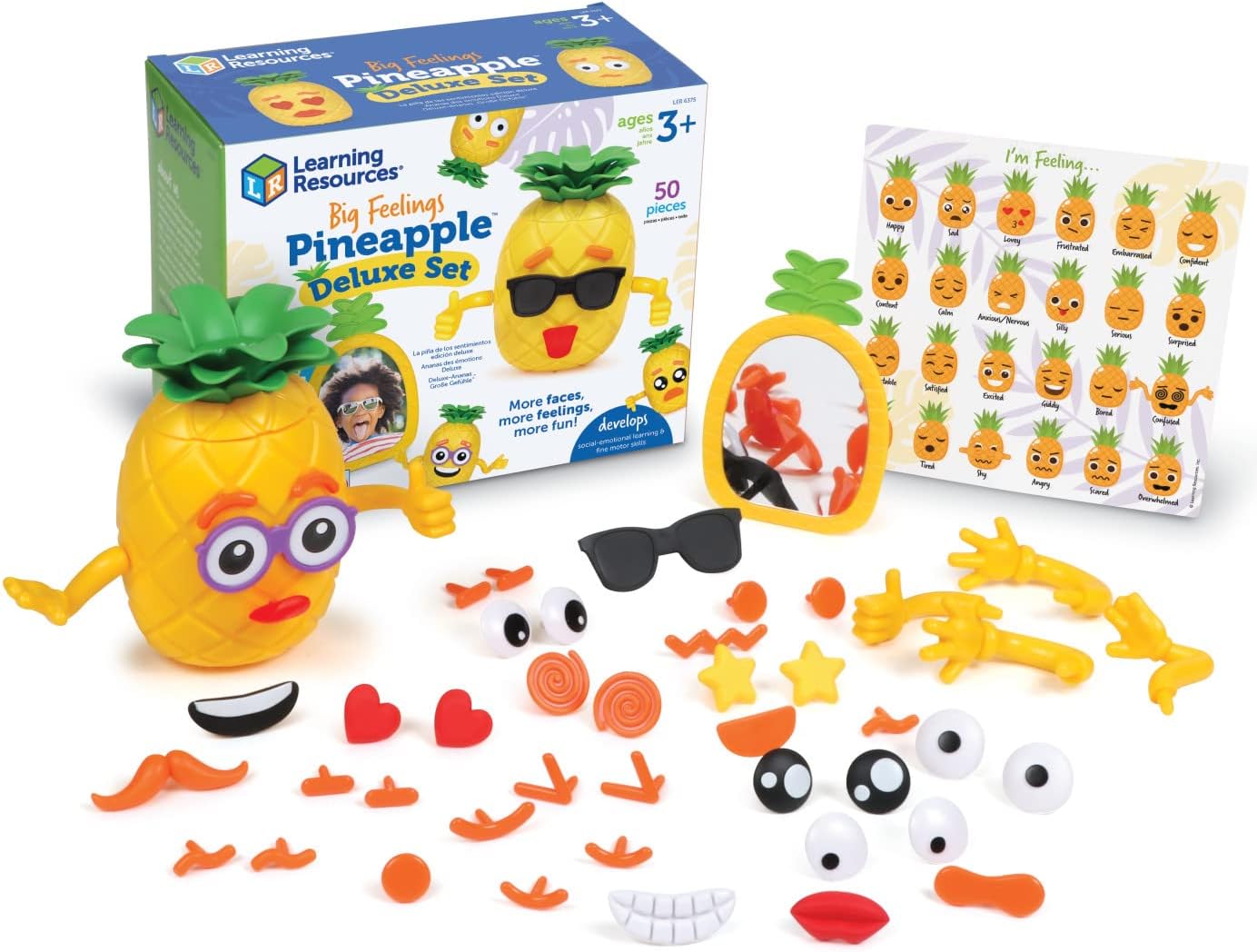
Learning Resources Big Feelings Pineapple
A cheerful pineapple with a secret: 26 pop-in face pieces stored inside its lid, ready to build every feeling from a huge grin to a grumpy scowl. Emotion words like happy, sad, angry and scared are some of the hardest for little ones to learn — because you can't point to them. This toy makes feelings visible.
We earn a tiny amount from qualifying purchases at no extra cost to you.
This toy stars in:
How to Use This Toy for Talking
Let your child explore first — follow their lead. Watch what they look at, copy what they do, and add words to their ideas rather than directing the play. Then weave in the goals below for your child's level. A few minutes of shared, chatty play beats a long structured session every time.
Speech Goals by Level
Pick your child's level — not sure? Read the level guide. Each level shows goals for understanding (receptive language — what your child takes in) and using words (expressive language — what they say). Understanding usually comes first, so it's completely normal for the two to be at different levels. And every card has a step down and a step up — meet your child where they are on the day.
🥉
Bronze · First Words
Understanding · receptive
- Point to eyes, nose and mouth when you name them
- Understand 'happy' and 'sad' faces you build together
- Follow 'Put it on' and 'Take it off'
Using words · expressive
- Say 'eye!', 'nose!', 'mouth!' while placing pieces
- Say 'happy!' with a big matching grin
- Say 'on' and 'off' as pieces pop in and out
- Say 'uh-oh!' when a piece goes somewhere silly
Key concepts
- Face parts
- Happy/sad
- On/off
- Silly
Finding it tricky? Drop all demands. Just play side by side and say the words for them — hearing words with zero pressure to speak is still powerful learning.
Too easy? If they copy words easily and use lots on their own, peek at Silver: take their word and add one of yours ('pop!' becomes 'big pop!').
🥈
Silver · Phrases
Understanding · receptive
- Follow 'Make him ANGRY' or 'Make her SURPRISED'
- Understand feeling words in stories: 'The boy feels scared'
Using words · expressive
- 'He's sad!'
- 'Happy face!'
- 'Big eyes!'
- 'He's mad!'
- 'Silly mouth!'
Language structures
- Pronoun + feeling (he's sad)
- Adjective + noun (angry eyes)
- Negation (not happy)
Finding it tricky? Step back to the Bronze single words. Say their word, then add just ONE more ('ball' → 'big ball') — no need for them to repeat it.
Too easy? If two-word phrases are flowing, start modelling the Gold sentences during play and leave a pause — many children will surprise you.
🥇
Gold · Sentences & Stories
Sentences to model · expressive
- 'The pineapple is angry because someone took his toy!'
- 'She looks surprised — her eyes are really big'
- 'First he was sad, but then his friend came and he was happy'
Higher language
- Explaining feelings: 'He's scared because it's dark'
- Linking feelings to events: 'I feel happy when we go to the park'
- Reading faces: 'I can tell she's cross because her eyebrows go down'
- Talking about fixing feelings: 'A hug would make him feel better'
Finding it tricky? Shrink your sentences back to the Silver phrases and slow right down — long sentences are harder to process in the middle of exciting play.
Too easy? Move into storytelling: ask 'what happened?' after play, retell it together, or explore the final bands of the Talking Journey.
Julia's Parent Tip
Build a face, then act it out with your own face and voice — droopy shoulders and a wobbly 'I feel saaad'. Children learn emotion words fastest when they see the same feeling in three places at once: the toy, your face, and a real moment ('You're frustrated, just like the pineapple!'). Naming a feeling is the first step to managing it.
Ready to turn this toy into talk time?
Grab it on Amazon, then come back to this page during play — the goals work best with the toy in hand.


