Cause & Effect Toys
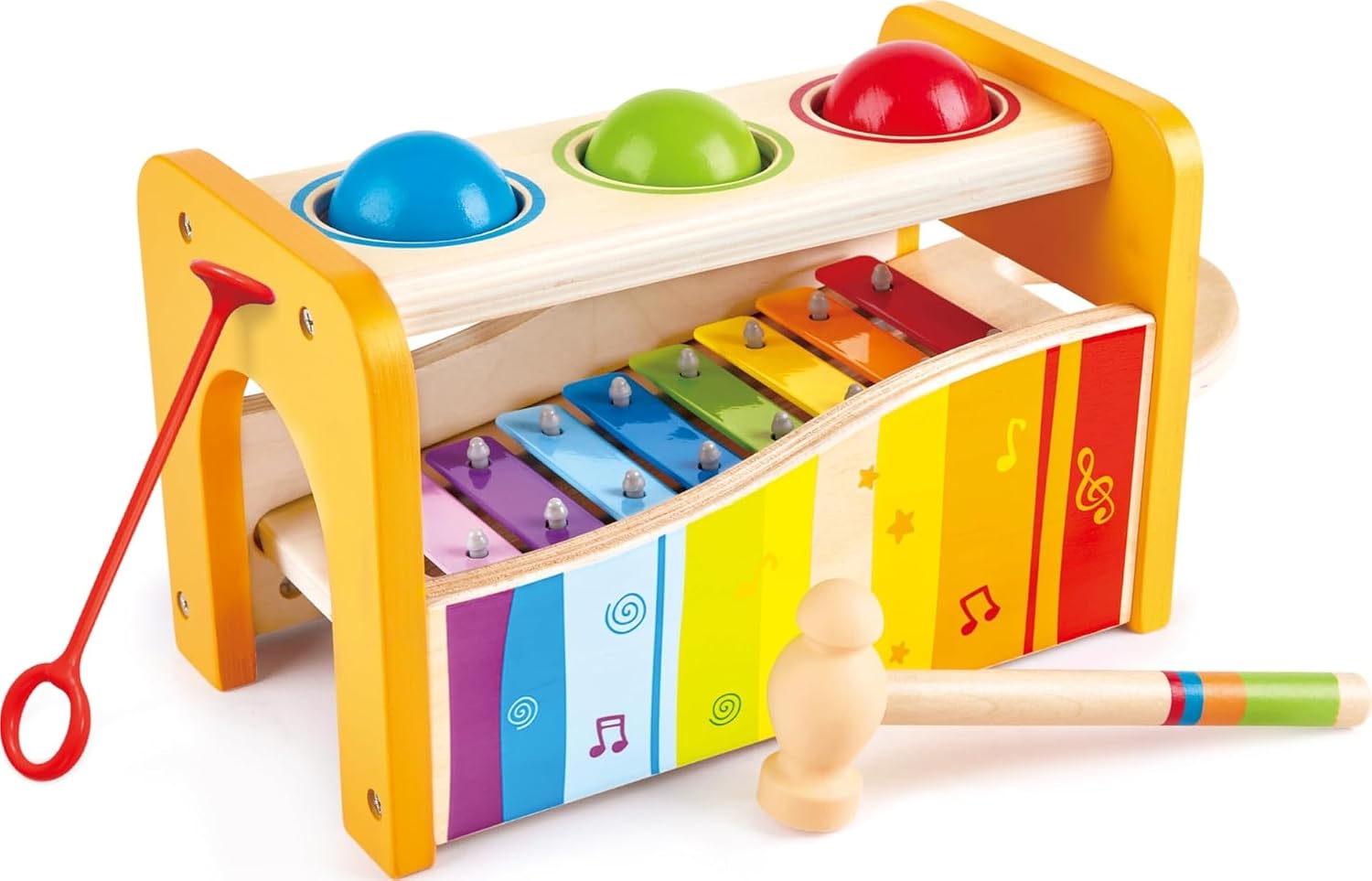
Hape Pound & Tap Bench with Xylophone
Hammer the balls and they drop, ding and roll down the hidden xylophone inside. Slide the xylophone out and it's a whole second instrument. This award-winning wooden bench is a masterclass in cause and effect — and in the sound words (bang! ding! boom!) that are often a child's very first 'words'.
We earn a tiny amount from qualifying purchases at no extra cost to you.
This toy stars in:
How to Use This Toy for Talking
Let your child explore first — follow their lead. Watch what they look at, copy what they do, and add words to their ideas rather than directing the play. Then weave in the goals below for your child's level. A few minutes of shared, chatty play beats a long structured session every time.
Speech Goals by Level
Pick your child's level — not sure? Read the level guide. Each level shows goals for understanding (receptive language — what your child takes in) and using words (expressive language — what they say). Understanding usually comes first, so it's completely normal for the two to be at different levels. And every card has a step down and a step up — meet your child where they are on the day.
🥉
Bronze · First Words
Understanding · receptive
- Follow 'Hit it!' and 'Stop!'
- Understand 'loud' and 'quiet' when you demonstrate
- Find the 'ball' and the 'hammer' when asked
Using words · expressive
- Say 'bang!' with every hammer hit
- Say 'down!' as balls drop through
- Say 'more!' to keep the music going
- Say 'ball' and 'ta-da!' as they roll out
Key concepts
- Loud/quiet
- Up/down
- Bang/ding
- More
Finding it tricky? Drop all demands. Just play side by side and say the words for them — hearing words with zero pressure to speak is still powerful learning.
Too easy? If they copy words easily and use lots on their own, peek at Silver: take their word and add one of yours ('pop!' becomes 'big pop!').
🥈
Silver · Phrases
Understanding · receptive
- Follow 'Tap it QUIETLY' vs 'Bang it LOUDLY'
- Understand 'fast' and 'slow' music
Using words · expressive
- 'Bang it loud!'
- 'Ball went down!'
- 'My turn!'
- 'Tap tap tap!'
- 'Do it again!'
Language structures
- Verb + adverb (tap quietly)
- Noun + verb + preposition (ball went down)
- Requesting a turn (my turn!)
Finding it tricky? Step back to the Bronze single words. Say their word, then add just ONE more ('ball' → 'big ball') — no need for them to repeat it.
Too easy? If two-word phrases are flowing, start modelling the Gold sentences during play and leave a pause — many children will surprise you.
🥇
Gold · Sentences & Stories
Sentences to model · expressive
- 'When I hit the ball, it falls down and makes music!'
- 'The red ball rolled all the way down the xylophone'
- 'I'm playing a fast song and then a slow song'
Higher language
- Explaining cause and effect: 'It dings because the ball lands on the keys'
- Comparing sounds: 'The big key is lower and the little key is higher'
- Taking turns as conductor: 'Now YOU play loud and I'll play quiet'
- Making patterns: 'Bang, tap, bang, tap — what comes next?'
Finding it tricky? Shrink your sentences back to the Silver phrases and slow right down — long sentences are harder to process in the middle of exciting play.
Too easy? Move into storytelling: ask 'what happened?' after play, retell it together, or explore the final bands of the Talking Journey.
Julia's Parent Tip
Play the 'loud/quiet game': whisper 'quiet...' while tapping gently, then shout 'LOUD!' and bang away together. Then hand over control — let your child call 'loud' or 'quiet' and you obey instantly. Being the boss of a grown-up's volume is irresistible, and it puts those opposite words straight into their mouth.
Ready to turn this toy into talk time?
Grab it on Amazon, then come back to this page during play — the goals work best with the toy in hand.